
On this page
When guards are worth it
- Big trees over the roof, especially oaks, maples or pines
- More than two cleanings a year
- A two-story or taller house where ladder work is risky
- Buried drains that keep clogging with leaves from the gutter
- Gutters in good condition
When they are not
- Few or no trees nearby
- Gutters near the end of their life
- A gutter that overflows because it is too small, not because it is clogged
- Cheap guards that will need replacing in a few years
The Brentwood case
Brentwood has been a Tree City USA for 37 years, and the city's approved planting list runs to 110 species. Most older subdivisions sit under mature hardwoods: oaks, maples, sweetgums, tulip poplars and hackberries, with pines on many lots. That mix drops debris almost all year, from oak catkins and maple seeds in spring to leaves, acorns and sweetgum balls in fall.
Brentwood's houses are also big. A two-story traditional with a walkout basement has a back wall that is three stories high. Each cleaning there is a long ladder and real risk.
And many houses have buried downspout drains. Leaves washed out of an open gutter end up in those lines, and a blocked drain is expensive to dig up. Guards protect the drains as much as the gutters.
Which guard
| Tree | Best guard |
|---|---|
| Oaks | Micro-mesh |
| Maples | Micro-mesh or perforated cover |
| Sweetgum | Any mesh or cover |
| Tulip poplar | Micro-mesh or reverse-curve |
| Pines | Micro-mesh only |
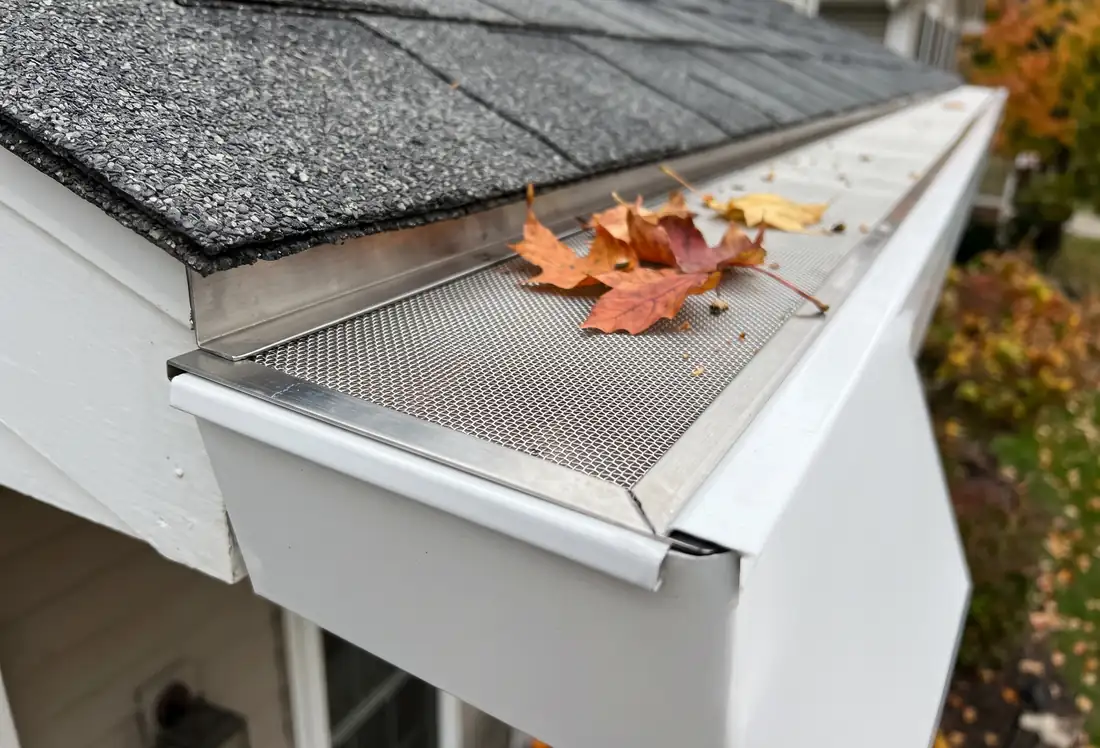
See micro-mesh guards and screen and reverse-curve guards.
Cost vs cleaning
Guards are priced per foot and vary widely by type and brand. A rough way to judge them: count how many cleanings a year you pay for now, multiply by the cost of each, and compare with the guard's installed price over the years it will last. Add the value of not having to get on a ladder, and of keeping buried drains clear.
Guards and ice
Ice coats guards as well as gutters. After the January 2026 ice storm, screwed-down micro-mesh on well-hung gutters generally held; snap-in screens often did not. Hang the gutter well, then add the guard.
A worked example
Picture a two-story house in Raintree Forest or Annandale with 260 feet of gutter under a pair of big oaks and a maple. Without guards, it needs a spring cleaning for catkins and seeds, a late-November cleaning for the main leaf drop, and often a follow-up in December. Each visit is a long ladder on a tall back wall, and leaves washed down the downspouts slowly fill the buried drains.
With stainless micro-mesh screwed to the gutters, the same house typically needs a brush-off or rinse once or twice a year, a look at the corners after the leaf drop, and a downspout flush now and then. The guard does not make the house maintenance-free, but it removes most of the ladder work and most of the debris that reaches the drains.
Whether that pays depends on what you pay for cleanings, how long you will own the house, and how much the buried drains would cost to dig up if they clog. On a big Brentwood house under mature trees, the numbers often favor guards within several years.
What a guard cannot fix
- A gutter that overflows at a valley because it is too small
- A run that holds water because the pitch has settled
- Water running behind the gutter because there is no drip edge
- A downspout that empties at the foundation
Fix those first, then add the guard.