
On this page
What does a new gutter system include?
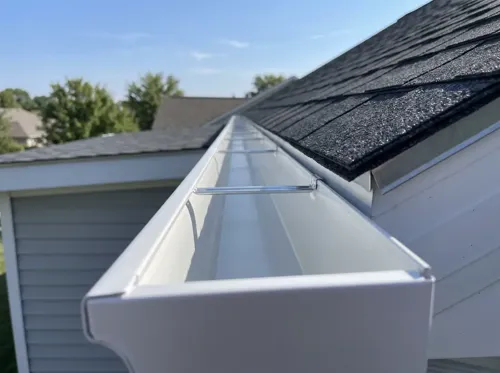
A gutter system is more than the trough. A complete installation covers everything from the roof edge to the place the water soaks in or drains away, and a quote should name each part.
| Part | What it does | What to look for in a quote |
|---|---|---|
| Drip edge or gutter apron | Metal flashing at the roof edge that sends water into the gutter, not behind it | Whether it is there, or will be added |
| Fascia | The board the gutter is fastened to | Probing for rot; replacement priced per foot |
| Gutter | The trough, usually K-style (ogee) or half-round | Size (5 or 6 inch), metal, thickness (.027 or .032 inch aluminum) |
| Hidden hangers | Screw-in brackets inside the gutter | Spacing, often 24 inches, closer under trees and where ice builds up |
| Miters | Corner joints: strip, box or hand-cut | How they are sealed and riveted |
| End caps | Closures at the run ends | Sealed and crimped |
| Outlets or drops | Holes where water leaves the gutter | Size matched to the downspout |
| Elbows (A and B style) | Bends that bring the downspout to the wall | Number per downspout |
| Downspouts | Vertical pipes, 2x3 or 3x4 inch | Count and size |
| Straps | Hold downspouts to the wall | Two or more per downspout |
| Extensions, splash blocks or drains | Carry water away from the foundation | Length and where they end |
How is a seamless gutter installed?
- Measure. The installer measures every run, notes each corner and outlet, and checks how much water each roof plane sends to each run.
- Check the roof edge. They look for a drip edge or gutter apron and probe the fascia and rafter tails for rot.
- Take down the old system. Spikes, ferrules, old hangers and downspouts come off, and the fascia is repaired or replaced where needed.
- Form the gutter. A roll-forming machine on a trailer shapes flat aluminum coil into one continuous length for each run.
- Snap the pitch. A chalk line sets a fall of about a quarter inch per 10 feet toward each outlet. Long runs are pitched both ways from the middle.
- Cut outlets and hang. Outlets are cut, the gutter is lifted into place and screwed through hidden hangers into the fascia.
- Miter and seal. Corners are mitered, riveted and sealed with gutter sealant; end caps are crimped and sealed.
- Run the downspouts. Elbows and downspouts are assembled, strapped to the wall and finished with extensions, splash blocks or a connection to a tested drain.
- Water test. A hose in each run shows whether water reaches the outlets and leaves the downspouts without backing up.
What size gutters does a house in Brentwood need?
Most Brentwood houses built in the 1970s and 1980s went up with 5-inch K-style gutters, and many still do fine with them. The ones that overflow are usually steep two-story houses with long roof planes, hip roofs where several planes empty into one corner, and the many-gabled traditionals of the 1990s and 2000s, where a valley dumps a whole slope into a few feet of gutter. Those often need 6-inch gutters with 3x4 downspouts.
Brentwood's average year brings about 54 inches of precipitation, more than most American cities. What tests a gutter is the heavy day. In March 2021, 8.16 inches fell in 24 hours, and on May 1 and 2, 2010, the city recorded 14 to 17 inches in under 30 hours. No residential gutter handles that, but one sized for a strong spring thunderstorm overflows far less in ordinary storms. See 5-inch vs 6-inch gutters.
| House | Typical size | Downspouts |
|---|---|---|
| One-story brick ranch in Brenthaven or along Moores Lane | 5-inch | 2x3 or 3x4, four to six |
| Two-story traditional in Raintree Forest, Annandale or Southern Woods | 5-inch, 6-inch on the long back runs | 3x4, six to ten |
| Large hip-roof house with valleys in the Governors Club | 6-inch | 3x4, with extra outlets near valleys |
| Antebellum or revival house with half-round | 5 or 6-inch half-round, sometimes copper | 3 or 4-inch round |
| New estate home on an acre in Morgan Farms or Calistoga | 6-inch, sometimes 7-inch on large planes | 3x4 into buried drains |
Which gutter material is best?
Aluminum is the default. It is light, does not rust, comes in dozens of baked-on colors and can be formed seamless on site. Ask for .032-inch coil if the house is under big trees or gets ice along the eaves. Copper costs several times as much and lasts decades, and it suits the brick and stone estate homes common in Brentwood. Galvanized and Galvalume steel are stronger than aluminum but rust where scratched. Vinyl is cheap but sags in summer heat and cracks in cold snaps.
Installation types
- Seamless gutters: one piece per run, joints only at corners and outlets.
- 6-inch gutters: for large or steep roofs and long runs.
- Half-round gutters: for older, historic and traditional-style houses.
- Copper gutters: for brick, stone, historic and estate homes.
- Aluminum gutters: the standard choice.
- Downspouts: sizing, placement and drainage.
Local conditions an installer should plan for
Trees. Brentwood has been a Tree City USA for 37 years, and the older subdivisions grew up under oaks, maples, sweetgums, tulip poplars and hackberries. Leaves and seeds mat at the outlets. Plan the outlets with a gutter guard in mind.
Ice. Snow is light most winters, but freezing rain is not rare. The January 2026 storm left about 0.75 inches of ice in Brentwood. Hangers every 24 inches, or closer, keep the gutter from bending under that load.
Big, tall walls. Brentwood's one-acre lots carry big houses, and many have a walkout basement that turns a two-story front into a three-story back. Ladders, staging and the cost per foot all change on those walls.
Clay over limestone. The county's soils are brown to reddish-brown clay over limestone. Downspout placement and extensions matter as much as the gutter. See downspouts and drainage in Brentwood.
What to ask an installer
- What size and thickness of gutter are you quoting, and why that size for this roof?
- How many downspouts, what size, and where will each one discharge?
- What hangers, at what spacing, and screwed into what?
- Will you probe the fascia, and how is rotten wood priced?
- Does the color meet my HOA's rules, if I have one?
- What license do you hold, and can you show a certificate of insurance?
See what gutters cost in Brentwood for price ranges.